


In the context of the global artificial intelligence race reshaping the international technology landscape, Vietnam is standing before a historic opportunity to transform itself from a technology outsourcing destination into a center for innovation and digital knowledge mastery. Beyond investing in digital infrastructure alone, the world’s emerging trend is now focused on building capabilities in AI research, semiconductor development, and especially technology transfer and localization of core technologies. This is also the strategic direction being pursued by DCH Technology Group through its large-scale AI ecosystem, high-tech research and technology transfer center, and hyperscale computing infrastructure project in Vietnam.
For many years, Vietnam has been recognized as a rapidly growing technology consumption market and software outsourcing hub. However, the explosive growth of generative AI, high-performance computing, and massive data demand is pushing the world into a new competitive era in which countries capable of mastering core technologies will hold economic and strategic security advantages for decades to come. Today, AI is no longer limited to chatbot applications or simple automation tools; it is becoming the new “operating system” of the digital economy. From logistics, healthcare, finance, and education to urban governance and national defense, every sector is being restructured around data and computational power.
This explains why major technology powers are investing hundreds of billions of dollars into AI data centers, supercomputers, and semiconductor technologies. In this new era, AI chips are considered the “oil” of the digital economy, while data has become a strategic national resource. Technology giants such as NVIDIA, Google, Microsoft, Meta, and AMD are no longer competing solely through products, but through their ability to control an integrated technology value chain that includes semiconductors, GPUs, hyperscale data centers, AI platforms, and software ecosystems.
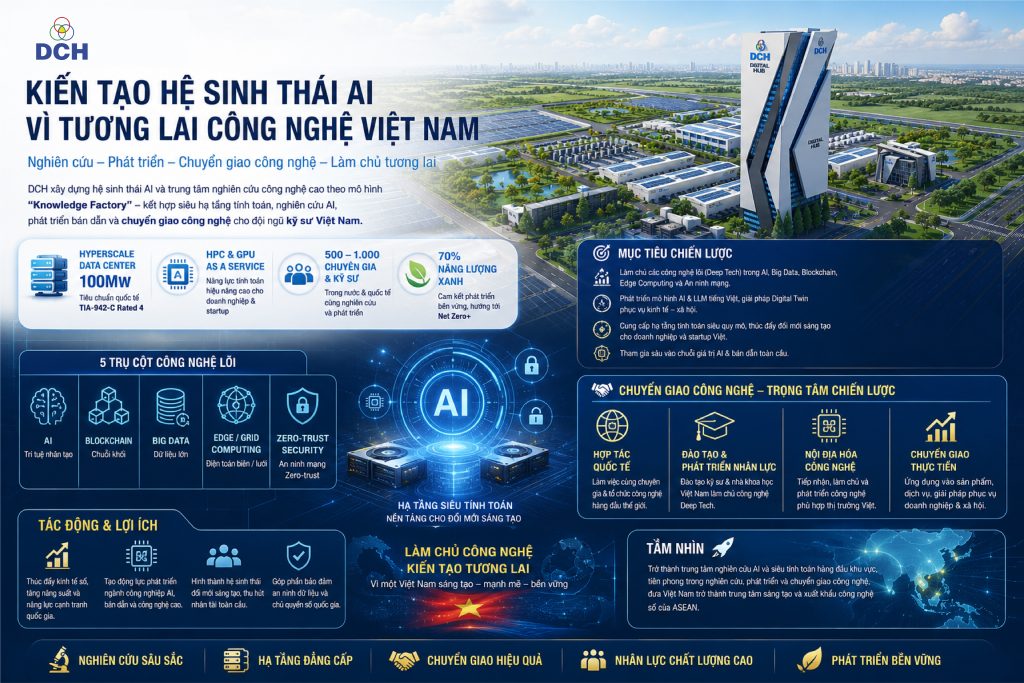
Vietnam now has a significant opportunity to integrate more deeply into this global value chain as the wave of high-tech investment diversification continues to accelerate across Asia. However, to fully seize this opportunity, Vietnam cannot remain merely a provider of infrastructure or low-cost labor. The country must gradually master technologies and develop domestic capabilities for technology absorption and knowledge transfer. This is precisely the key differentiator in DCH’s development strategy, as the project is positioned not simply as a conventional data center, but as a “Knowledge Factory” — a large-scale ecosystem integrating AI research, high-performance computing, technology transfer, and advanced workforce development.
According to DCH’s announced roadmap, the company plans to develop a hyperscale AI and storage ecosystem consisting of five DC Hall buildings meeting the highest international TIA-942-C Rated 4 standard, with a total capacity of up to 100MW. This infrastructure will play a crucial role in training large-scale AI models, developing Vietnamese large language models (LLMs), and supporting future high-performance computing applications. More importantly, however, the project places research and technology transfer at the center of its long-term vision.

Rather than operating solely as an infrastructure provider, DCH aims to establish specialized Deep Tech laboratories focusing on AI, Blockchain, Big Data, Edge Computing, and Zero-Trust Cybersecurity. The objective is not only to utilize foreign technologies but also to gradually absorb knowledge, localize solutions, and build a Vietnamese engineering workforce capable of participating in the global innovation chain. In the AI era, countries with strong engineering and research talent will possess a much greater long-term strategic advantage than those relying solely on capital investment.
One of the most critical challenges facing the AI industry today is the severe shortage of computational infrastructure. Training next-generation AI models requires thousands of high-performance GPUs, advanced cooling systems, and highly stable power supplies — all involving enormous investment costs. Therefore, DCH’s strategy of developing HPC infrastructure and GPU-as-a-Service (GaaS) solutions carries particular significance for Vietnam’s startup ecosystem and domestic technology enterprises. This approach enables Vietnamese companies to access world-class computing capabilities without having to invest millions of dollars in hardware themselves.
Beyond AI, the project also lays an important foundation for semiconductor research and development. In the global semiconductor value chain, hyperscale AI data centers and semiconductor technologies are deeply interconnected. Modern AI GPUs represent some of the most advanced semiconductor products in existence, while AI data centers are among the largest consumers of these chips worldwide. The development of hyperscale AI systems will inevitably drive demand for chip design engineers, embedded systems specialists, FPGA engineers, and AI hardware optimization experts. This could become a stepping stone for Vietnam to move deeper into the semiconductor industry beyond assembly and testing operations.
Most importantly, technology transfer is positioned as the core strategic pillar of the entire development model. For years, Vietnam’s biggest limitation has not been a lack of investment capital, but rather insufficient mechanisms for absorbing and localizing advanced technologies. Many previous high-tech projects focused primarily on manufacturing or infrastructure leasing without generating substantial knowledge spillover. DCH’s approach aims to establish a real-world research environment where international experts and Vietnamese engineers can collaborate directly, conduct research, and transfer technologies through hands-on operations and continuous training. This is strategically important because technology cannot be fully transferred through documents or equipment alone; it requires practical collaboration, real-world experience, and local talent development.
The establishment of a large-scale AI research ecosystem could also create a powerful multiplier effect for universities, research institutes, and technology startups across Vietnam. With access to hyperscale computing infrastructure and international sandbox environments, Vietnamese enterprises would have the opportunity to develop specialized AI products tailored to domestic and regional markets, including Vietnamese AI assistants, healthcare AI, financial AI, smart logistics systems, and Digital Twin solutions for urban governance. This direction offers significantly higher long-term value than traditional outsourcing services.
As AI increasingly becomes the foundational technology of every industry, the key question is no longer whether organizations should adopt AI, but rather who will own and control AI capabilities. Countries capable of mastering data, data centers, AI chips, and highly skilled digital talent will hold decisive competitive advantages in the global economy. Therefore, the development of an AI ecosystem integrated with semiconductor research and technology transfer is not only an economic issue but also a matter of digital sovereignty and technological security.
The emergence of hyperscale AI projects in Vietnam also sends a strong signal regarding the country’s ambition to participate more deeply in the global technology value chain. If implemented effectively, these projects will not merely serve as facilities for server hosting or data storage, but as strategic infrastructure supporting Vietnam’s knowledge economy for decades to come. More importantly, by focusing on research, workforce training, and technology transfer, Vietnam can avoid being trapped as a technology consumption market and instead gradually evolve into a creator and exporter of digital knowledge for ASEAN and the broader global market.
In the global AI race, time itself is a competitive advantage. Countries that move faster will secure stronger positions in the emerging technology order. Through investments in hyperscale AI infrastructure, high-performance computing, semiconductor research, and technology transfer, Vietnam now has an opportunity to achieve a major leap in national technological capability. In this journey, initiatives such as DCH’s AI ecosystem may become one of the key driving forces behind the formation of Vietnam’s next-generation AI economy and digital knowledge industry.
